
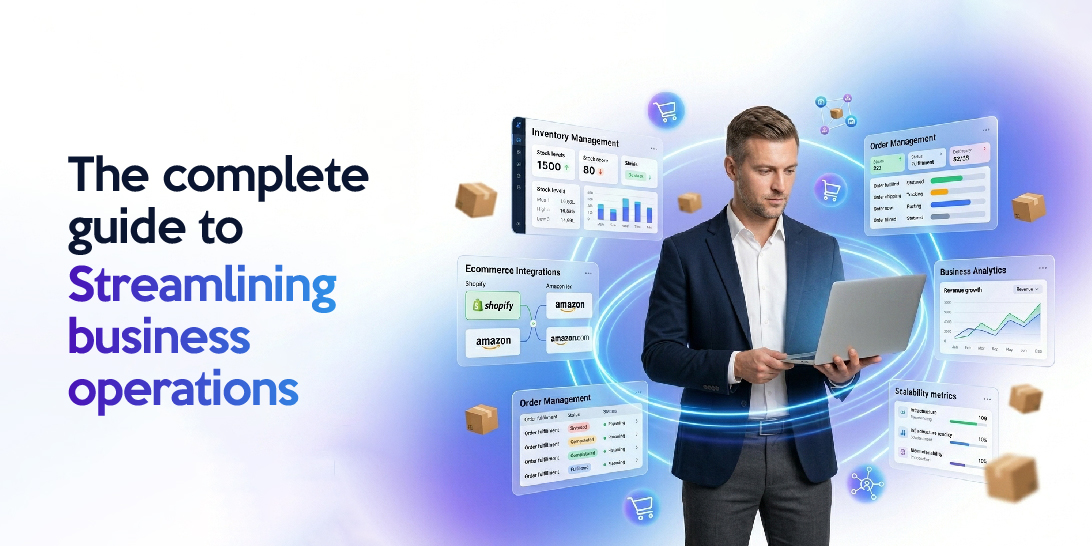
IntroductionWhy complexity follows growth
Growth is often seen as a sign of success. More customers, more orders, and more opportunities usually mean a business is moving in the right direction. Yet growth also introduces complexity.
What worked when a business had a small team and a manageable number of transactions often starts breaking down as operations expand. Inventory lives in one system, sales data in another, finance relies on spreadsheets, and reporting requires information from multiple departments. Teams spend more time searching for answers than acting on them.
This is where ERP software becomes essential.
For many modern businesses, ERP software is not simply another technology investment. It is the foundation that connects people, processes, and information across the organization. Instead of managing disconnected systems and manual workflows, businesses gain a unified platform that provides visibility, control, and efficiency.
Whether you're exploring ERP software for the first time or evaluating options for future growth, understanding how ERP works can help you make better operational decisions.
01 · The basicsWhat is ERP software?
ERP software, short for Enterprise Resource Planning software, is a centralized business management system designed to connect core business functions into one integrated platform.
Rather than operating separate systems for inventory, accounting, purchasing, sales, and reporting, ERP software brings these processes together so information flows automatically across departments.
Everyone works from the same data. When information is updated in one area of the business, the change becomes visible across relevant functions. This eliminates data silos and helps teams make decisions using accurate, real-time information.
Modern ERP software is less about managing software and more about managing business operations efficiently.
02 · The frictionWhy businesses outgrow disconnected systems
Most organizations do not suddenly wake up and decide they need ERP software. The need usually appears gradually.
At first, spreadsheets are enough. Teams communicate through email. Information is shared manually. For smaller operations, this approach often works.
As the business grows, however, cracks begin to appear.
Sales teams may promise products that are no longer available. Finance teams spend days reconciling reports. Purchasing teams lack visibility into inventory levels. Management struggles to obtain a complete picture of performance.
These challenges create what many businesses experience as operational friction.
Common signs
- Duplicate data entry
- Inventory discrepancies
- Delayed reporting
- Poor visibility across departments
- Slow decision-making
- Manual workflows
- Increased administrative workload
While each issue may seem minor individually, together they can significantly impact growth and profitability. ERP software helps eliminate these inefficiencies by creating a single source of truth across the organization.
03 · The mechanicsHow ERP software works
The easiest way to understand ERP software is to look at how information moves through a business.
Imagine a customer places an order.
Without ERP software, multiple departments may need to update records manually. Sales confirms the order. Inventory adjusts stock levels. Finance generates invoices. Purchasing monitors replenishment requirements. Each step often relies on separate systems and manual communication.
With ERP software, these processes become connected. The order automatically updates inventory. Financial records are generated. Relevant departments receive updates. Management dashboards reflect the transaction immediately.
This creates a more efficient workflow while reducing the risk of human error.
04 · The modulesCore components of ERP software
Modern ERP systems are typically built around several key modules. Organizations can implement the functionality they need today while maintaining the flexibility to expand later.
Financial management
Financial management serves as the foundation of most ERP systems. Capabilities often include:
- General ledger
- Accounts payable
- Accounts receivable
- Cash flow management
- Budgeting
- Financial reporting
Because nearly every business activity impacts finances, integrated financial visibility is one of the most valuable benefits of ERP software.
Inventory management
Inventory accuracy directly affects customer satisfaction and profitability. ERP software helps businesses:
- Track stock in real time
- Reduce stockouts
- Avoid overstocking
- Improve inventory forecasting
- Maintain accurate warehouse visibility
For product-based businesses, inventory management often delivers some of the fastest operational improvements.
Sales and order management
Sales teams require accurate information to serve customers effectively. ERP software supports:
- Quotations
- Order processing
- Customer records
- Pricing management
- Fulfillment coordination
- Invoicing
This creates a smoother experience for both customers and internal teams.
Procurement and purchasing
Procurement functionality helps businesses manage supplier relationships and purchasing activities. Key capabilities may include:
- Vendor management
- Purchase orders
- Approval workflows
- Supplier performance tracking
- Automated replenishment
These features help organizations maintain stronger control over supply chain operations.
Manufacturing and production
Manufacturing businesses often require additional operational functionality. ERP software may support:
- Production planning
- Bills of materials
- Work orders
- Capacity planning
- Quality control
By improving visibility across production processes, manufacturers can increase efficiency while maintaining consistency.
05 · The payoffThe biggest benefits of ERP software
Organizations invest in ERP software because of the measurable value it can create across operations.
Better visibility
One of the most significant advantages is visibility. Instead of waiting for reports from multiple departments, leadership teams can access current information through centralized dashboards and reporting tools.
Better visibility leads to better decisions.
Increased efficiency
Manual processes consume valuable time and resources. ERP software automates repetitive activities, helping employees focus on higher-value work.
Efficiency is not about working harder. It's about removing unnecessary effort.
Improved decision-making
Accurate information supports stronger decision-making. When teams work from a unified platform, planning, forecasting, and operational execution become more reliable.
Greater scalability
Growth introduces complexity. ERP software helps businesses scale operations while maintaining consistency and control. New customers, products, locations, and employees can be managed without dramatically increasing administrative effort.
Enhanced customer experience
Customers expect accuracy, speed, and reliability. ERP software improves customer experiences by helping teams access the information they need to respond quickly and accurately.
06 · The triggerSigns it's time to invest in ERP software
Not every business needs ERP software immediately. However, several indicators suggest that an organization may be ready.
You may need ERP software if:
- Reporting takes too long
- Inventory accuracy is declining
- Departments operate in silos
- Employees duplicate data across systems
- Growth creates operational bottlenecks
- Decision-making is slowed by poor visibility
- Customer service is impacted by inconsistent information
When multiple challenges appear simultaneously, ERP software often becomes a practical solution rather than a future consideration.
07 · Common mistakesCommon ERP implementation mistakes
ERP implementation can create significant business value, but success depends on preparation and execution.
Focusing on features instead of business goals
Many organizations begin by comparing software features. A better approach is to define operational objectives first.
Ask: What business problems are we trying to solve?
The answer should guide software selection.
Migrating poor-quality data
ERP systems depend on reliable information. Migrating inaccurate or outdated data often creates unnecessary problems. Before implementation, businesses should review and clean critical records.
Ignoring user adoption
Technology alone does not create results. Employees must understand how to use the system effectively. Training and change management are essential for long-term success.
Trying to do everything at once
A phased implementation approach often reduces risk and improves adoption. Successful ERP projects focus on sustainable progress rather than rapid deployment.
08 · The decisionHow to choose the right ERP software
Selecting ERP software requires more than comparing features. Businesses should evaluate several factors carefully.
Industry alignment
Different industries have different requirements. Choose a solution that supports your operational needs.
Ease of use
Adoption depends heavily on usability. Employees are more likely to embrace systems that are intuitive and efficient.
Scalability
The ERP platform should support future growth, not just current operations.
Integration capabilities
ERP software should connect effectively with existing business tools and technologies.
Vendor support
Implementation assistance, training resources, and ongoing service can significantly impact long-term success.
09 · FAQFrequently asked questions
What is ERP software used for?
ERP software helps businesses manage and connect finance, inventory, purchasing, sales, operations, and reporting through a single integrated platform.
Is ERP software only for large businesses?
No. Modern ERP solutions are widely used by small and mid-sized businesses that need better visibility and operational control.
What are the main ERP modules?
Common modules include finance, inventory management, procurement, sales, manufacturing, and reporting.
How long does ERP implementation take?
Implementation timelines vary depending on business size, complexity, and requirements. Projects can range from a few weeks to several months.
Can ERP software improve productivity?
Yes. By automating workflows and reducing manual tasks, ERP software helps improve operational efficiency and employee productivity.
10 · ConclusionConclusion
ERP software has become one of the most important operational tools for modern businesses.
As organizations grow, disconnected systems often create challenges that limit visibility, slow decision-making, and increase complexity. ERP software addresses these issues by bringing information, workflows, and departments together in a unified environment.
The greatest value of ERP software is not simply automation. It is the ability to create clarity across the organization.
When teams have access to accurate information, streamlined processes, and connected workflows, businesses are better positioned to scale, compete, and grow with confidence.
Unify inventory, purchasing, fulfillment, finance, and ecommerce operations through one centralized platform.
Improve visibility, streamline workflows, and support business growth with Zeper Go.