
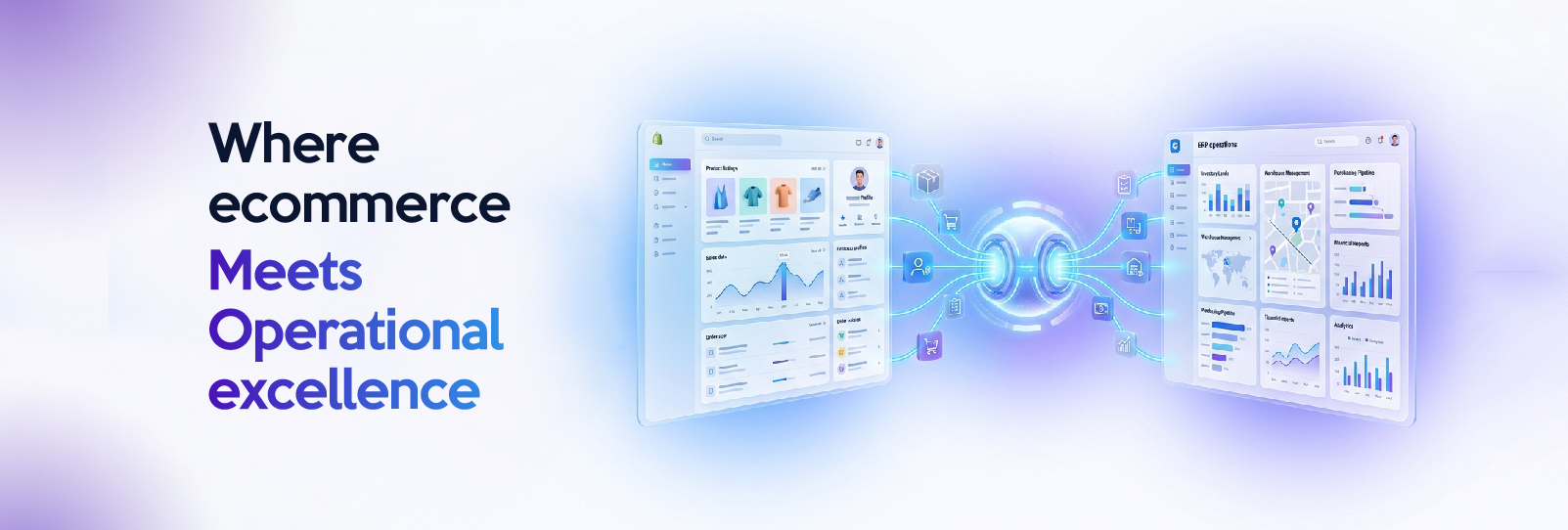
Shopify has become one of the most popular ecommerce platforms for growing businesses. Its ease of use, extensive app ecosystem, and scalability make it an attractive solution for brands looking to sell online. However, as order volumes increase and operations become more complex, many businesses discover that managing ecommerce activities through Shopify alone is not enough.
Inventory needs to stay synchronized across sales channels. Orders must flow efficiently through fulfillment processes. Purchasing teams require accurate stock information. Finance departments need visibility into transactions and profitability.
When these functions operate across separate systems, inefficiencies often emerge. Teams spend time manually updating information. Inventory records become inconsistent. Reporting becomes fragmented. Decision-making becomes more difficult.
This is where Shopify ERP integration becomes valuable. By connecting Shopify with an ERP system, businesses can create a centralized operational environment that improves visibility, automates workflows, and supports sustainable growth.
For many growing ecommerce companies, ERP integration becomes a critical step in moving from reactive operations to scalable business management.
01 · The basicsWhat is Shopify ERP integration?
Shopify ERP integration is the process of connecting a Shopify store with an Enterprise Resource Planning (ERP) system. The goal is to enable data to flow automatically between ecommerce operations and core business functions.
This typically includes:
- Inventory management
- Order processing
- Purchasing
- Warehouse operations
- Financial management
- Customer information
- Reporting and analytics
Instead of manually updating information across multiple platforms, integrated systems synchronize data automatically.
Shopify manages customer-facing ecommerce activities, while the ERP system manages the operational processes that support them. Together, they create a more connected and efficient business environment.
02 · Why integrateWhy growing Shopify businesses need ERP integration
Many businesses start successfully with Shopify and a collection of supporting applications. Initially, this approach works well. However, as growth accelerates, operational complexity often increases faster than expected.
Common challenges include:
- Inventory discrepancies
- Manual order processing
- Delayed reporting
- Multiple data sources
- Purchasing inefficiencies
- Fulfillment bottlenecks
As transaction volumes increase, these issues become more difficult to manage manually. ERP integration helps address these challenges by creating a single source of truth for operational information.
The more a business grows, the more important operational visibility becomes.
03 · The benefitsKey benefits of Shopify ERP integration
The value of integration extends across multiple departments and business processes.
Real-time inventory visibility
Inventory accuracy is one of the most significant benefits of ERP integration. Without synchronization, inventory information can become outdated quickly. This may lead to:
- Overselling
- Stock shortages
- Customer dissatisfaction
- Fulfillment delays
ERP integration enables inventory updates to flow automatically between Shopify and operational systems. This provides greater confidence in inventory availability and replenishment planning.
Faster order processing
Order information can move automatically from Shopify into ERP workflows. Benefits include:
- Reduced manual entry
- Faster processing
- Improved order accuracy
- Better fulfillment visibility
Automation helps eliminate delays that commonly occur in disconnected environments.
Improved purchasing decisions
Purchasing teams depend on accurate inventory data. Integrated systems provide visibility into:
- Available inventory
- Incoming inventory
- Sales activity
- Replenishment requirements
This supports more informed purchasing decisions.
Better financial visibility
ERP systems help connect ecommerce activity with financial reporting. Businesses gain greater visibility into:
- Revenue performance
- Product profitability
- Inventory valuation
- Cash flow
Financial and operational information become more valuable when managed through connected systems.
Centralized reporting
Business leaders often struggle with fragmented reporting environments. Integration helps create a unified view of:
- Inventory performance
- Sales activity
- Operational metrics
- Financial results
This supports faster and more informed decision-making.
04 · What syncsCommon data points shared between Shopify and ERP systems
A successful integration typically synchronizes multiple types of information.
Inventory data
Inventory synchronization may include:
- Available stock
- Inventory adjustments
- Warehouse inventory
- Product availability
Order information
Orders often flow directly into ERP workflows for processing and fulfillment. This may include:
- Customer details
- Products ordered
- Shipping information
- Payment status
Product information
Product data synchronization helps maintain consistency across systems. Examples include:
- Product descriptions
- Pricing information
- Product variants
- SKU information
Customer records
Integrated customer information supports better service and reporting.
Financial data
Many businesses synchronize:
- Sales transactions
- Tax information
- Payment records
- Financial reports
Accurate data synchronization is the foundation of a successful ERP integration.
05 · The challengesCommon Shopify ERP integration challenges
While the benefits are substantial, businesses should also understand potential challenges.
Data inconsistencies
Poor data quality can create integration issues. Examples include:
- Duplicate records
- Incorrect SKUs
- Missing inventory information
- Inconsistent product data
Data should be reviewed and cleaned before integration begins.
Process misalignment
Technology alone cannot solve inefficient processes. Businesses should evaluate existing workflows before implementation.
Integration complexity
The complexity of integration often depends on:
- Number of systems involved
- Custom workflows
- Business requirements
- Existing infrastructure
Careful planning helps reduce implementation challenges.
Change management
Employees may need training and support as new workflows are introduced. Successful adoption requires clear communication and structured onboarding.
06 · Best practicesBest practices for Shopify ERP integration
Organizations that achieve successful integrations often follow a structured approach.
Define business objectives
Before implementation begins, identify the goals of integration. Examples may include:
- Improving inventory visibility
- Reducing manual work
- Accelerating fulfillment
- Improving reporting
Clear objectives help guide decision-making throughout the project.
Standardize operational processes
Integration works best when workflows are clearly defined and consistent. Review processes such as:
- Inventory management
- Order processing
- Purchasing
- Reporting
Ensure data accuracy
Clean and accurate data is essential. Businesses should validate:
- Product information
- Inventory records
- Customer data
- Financial information
Prioritize automation opportunities
Focus on workflows that deliver the greatest operational impact. Common candidates include:
- Order synchronization
- Inventory updates
- Purchase order generation
- Reporting
Test before full deployment
Testing helps identify issues before they affect daily operations. Businesses should validate:
- Data synchronization
- Workflow functionality
- Reporting accuracy
- User access controls
Successful integrations are built on preparation, testing, and continuous improvement.
07 · Scaling upHow Shopify ERP integration supports business growth
Growth often introduces new operational challenges. Businesses may add:
- New products
- Additional warehouses
- More employees
- New sales channels
- Higher order volumes
Without integrated systems, complexity increases rapidly. ERP integration helps businesses scale by providing:
Better visibility
Leaders gain access to centralized operational information.
Improved efficiency
Automation reduces manual workloads and improves consistency.
Stronger inventory control
Real-time visibility helps maintain inventory accuracy across channels and locations.
Scalable operations
Integrated systems help support growth without requiring significant increases in administrative effort.
Businesses that scale successfully often have connected systems supporting their operations behind the scenes.
08 · FAQFrequently asked questions
What is Shopify ERP integration?
Shopify ERP integration connects a Shopify store with an ERP system to synchronize inventory, orders, financial data, and operational processes.
Why is Shopify ERP integration important?
It improves visibility, reduces manual work, increases inventory accuracy, and supports business growth.
Can ERP integration improve inventory management?
Yes. Integration provides real-time inventory visibility and automated inventory synchronization.
What business processes benefit from ERP integration?
Inventory management, purchasing, fulfillment, financial reporting, order processing, and operational analytics all benefit.
Is Shopify ERP integration suitable for small businesses?
Yes. Many growing businesses implement ERP integration to support increasing operational complexity.
What is the biggest challenge in ERP integration?
Data quality and process alignment are among the most common challenges.
09 · ConclusionConclusion
Shopify provides a powerful foundation for ecommerce growth, but long-term success often requires more than a storefront platform.
As businesses scale, inventory management, order processing, purchasing, fulfillment, and financial reporting become increasingly interconnected. Managing these activities through separate systems can create inefficiencies that limit growth.
Shopify ERP integration helps solve this challenge by creating a connected operational environment where information flows seamlessly between ecommerce and business operations.
Organizations that invest in integration gain greater visibility, stronger operational control, improved efficiency, and a scalable foundation for future growth.
For growing ecommerce businesses, Shopify ERP integration is often not just a technology upgrade. It is a strategic investment in operational excellence.
Unify inventory, purchasing, fulfillment, finance, and ecommerce operations through one centralized platform.
Gain real-time visibility and build a more scalable ecommerce business with Zeper Go.